Published on 10 November 2026
A rug pad is not mandatory under a Berber rug, but it is highly recommended on smooth floors (parquet, tiles, polished concrete) to stop the rug from slipping, keep the corners flat and protect your floor. It is also compatible with underfloor heating, provided you choose a model its manufacturer has designed for this use.
Our Berber rugs are handwoven in the Atlas Mountains by weavers we work with directly. They are pieces made to last for years. Here is our advice for laying them with peace of mind in your home, with or without underfloor heating.
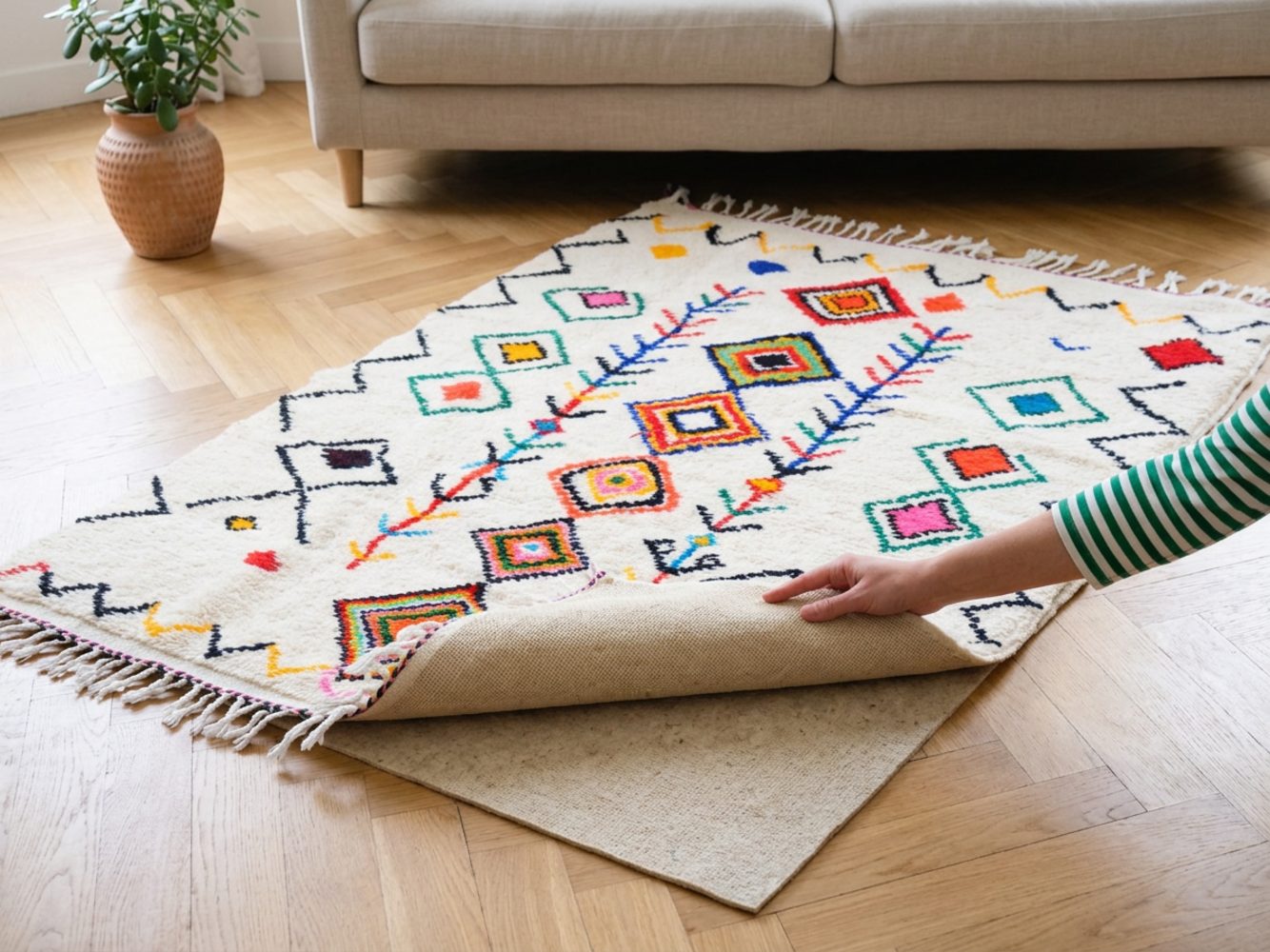
A rug pad is a thin layer slipped between the floor and the rug. Its main role is to stop the rug from slipping, which makes it safer day to day, especially in high-traffic areas: entrance, hallway, in front of the sofa.
It has other benefits too:
Without a rug pad, a rug laid on a smooth floor tends to shift slightly each time someone walks over it. These small repeated movements end up moving it out of place, curling the corners and wearing the wool where it touches the floor.
No. It all depends on your floor, where the rug is placed and its type.
This is where a rug pad is most useful. On a smooth floor, even a heavy rug can end up slipping with repeated footsteps.
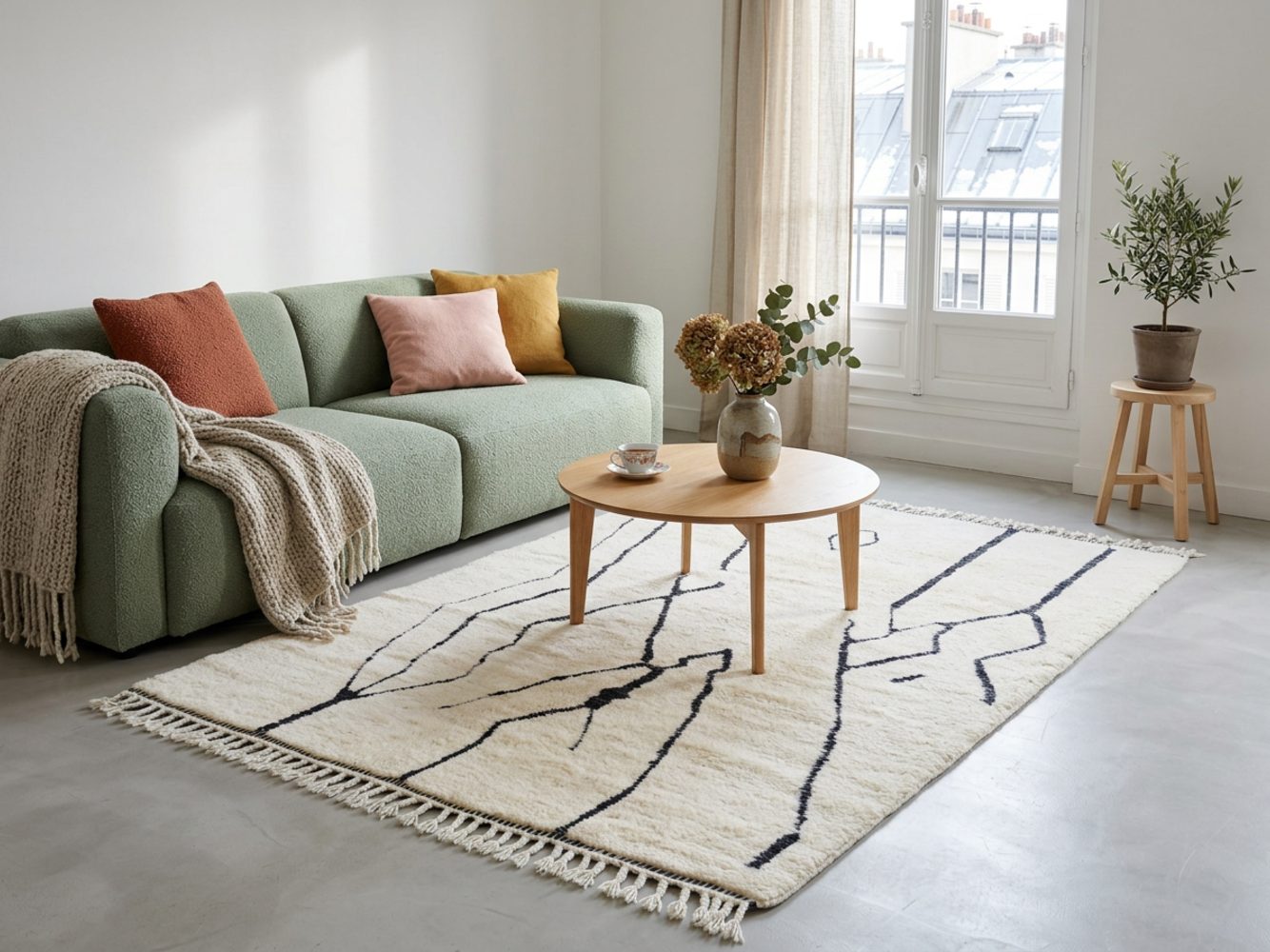
When the furniture legs rest on the rug, it moves much less. A rug pad is still advisable if part of the rug is in a high-traffic area. To position your rug properly in relation to your furniture, see our guide on how to choose the size of your Berber rug.
Kilim rugs, which are flatwoven, are thinner and lighter: they tend to slip more. High-pile rugs such as Beni Ouarain rugs are heavier and stay in place better, but a rug pad is still useful on a smooth floor.
Rug pads are mainly made of natural rubber, felt, or a combination of both. Rubber grips the floor well, felt adds softness. Always check that the manufacturer states its product is compatible with your floor covering (varnished or oiled parquet, vinyl, stone…), as some materials can mark certain floors.
Choose a rug pad slightly smaller than your rug, by a few centimetres on each side, so that it does not show. Many models can easily be trimmed with scissors, which is handy for a round rug or a runner.
In an entrance or a hallway, go for a thin model so that doors do not rub. In a living room or bedroom, you can choose a little more thickness for comfort, unless your floor is heated.

Yes, a rug pad is compatible with underfloor heating, as long as you choose it carefully. Each layer laid on a heated floor slightly slows down the spread of heat into the room. The idea is therefore to choose a rug pad that lets heat through as well as possible.
Good to know: a thin rug pad under a thick rug is still a stack of layers. It is the whole set, rug included, that you need to take into account to keep a room well heated.
The rug itself also plays a role. Wool is a naturally insulating material: the thicker a rug is, the more it holds back the heat rising from the floor.
A flatwoven rug such as a Kilim will let heat through better than a high-pile rug. It is a good choice for a room where underfloor heating is the only source of heat.
A soft Beni Ouarain or Azilal can absolutely find its place on a heated floor. Pair it with a thin, suitable rug pad, and bear in mind that the covered area will heat up a little more slowly. In return, you will enjoy the softness of wool underfoot all winter long.
Yes, it helps. By limiting slipping and friction against the floor, it reduces wear on the back of the rug and helps it stay flat.
A handwoven Berber rug is a piece made to stand the test of time. A good rug pad, combined with regular care, is one of the simple ways to look after it. Also remember to lift the rug from time to time to vacuum the floor and the rug pad.
Do you have children or pets? A rug pad also adds stability in very busy rooms. Find all our advice in our article are Berber rugs suitable for children and pets?
At Them, we buy our rugs directly at the source, from the weavers, and offer them at fair prices all year round. Taking care of your rug also means making the work of these artisans and a precious know-how last.
No. It is mainly recommended on smooth floors such as parquet, tiles or polished concrete, to stop the rug from slipping.
Yes, if it is thin and its manufacturer states it is compatible with underfloor heating. Avoid thick foams, which slow down heat more.
It does not block it, but it slows it down more than a thin rug. If the room is heated only by the floor, a flatwoven rug such as a Kilim is a good choice.
A rug pad slightly smaller than the rug, by a few centimetres on each side, so that it stays invisible.
Some materials can mark certain floor coverings. Choose a model that its manufacturer states is compatible with your type of floor.